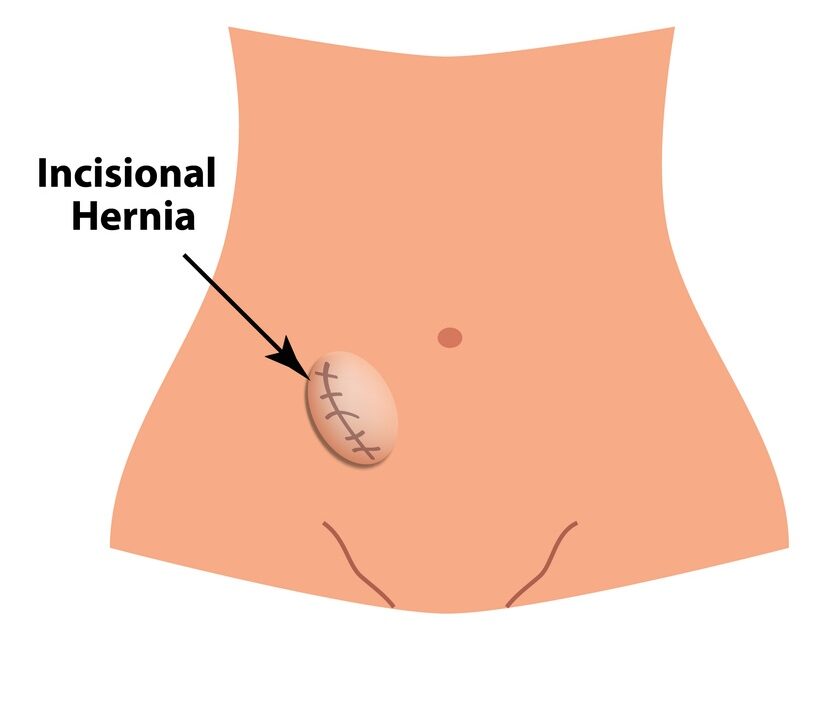
At Hernia Clinic Hampshire, we have extensive experience treating more complex hernias such as incisional hernias. Our friendly team is happy to assist with any questions you might have, book you in to see our expert Consultant Surgeon, and to help you at every step of your journey to recovery with us.
Incisional hernias occur through an old surgical incision. The wound remodels and gains strength over the first year after surgery, but is never as strong as it was before the incision was made. The more times the same incision is opened, the weaker it becomes.
Additional risks include smoking, which prevents strong connective tissue, and a higher BMI, which puts more pressure on the abdominal wall, particularly where there is an old incision.
Incisional hernia repair is more complex and often needs imaging as there are usually multiple defects that need repairs. When these additional defects are identified during surgery, they too can be repaired. This means incisional hernia repair surgery is performed under general anaesthetic.
Our Consultant Surgeon will discuss what is needed and form a treatment plan for your individual case.
We provide extensive information on what to expect after surgery and how to improve your recovery. We recommend reading our Post-Surgery Advice Leaflet and using our Hernia Recovery Programme for more information. It is particularly important to use a hernia support while recovering from this operation.
How Much Does Incisional Hernia Surgery Cost?
Prices can vary depending on your individual situation and the approach needed. Talk to us for a price estimate.
For Complex Abdominal Hernias: Open Component Separation Technique (CST)
Large incisional hernias and other ventral hernias with multiple tissue defects are very difficult to repair and the surgery needs good planning. Component separation is a technique that is well practiced amongst hernia surgeons.
Over a wide area, the surgeon releases the fascia (connective tissue) from the muscle in order to reduce tension on the repair. This gives the surgeon more space to close the hernia defect.
This technique minimises tissue loss and reduces the risk of recurrence. It needs a general anaesthetic and an average stay of 2 nights after surgery.
Our consultant surgeon will meet with you, discuss options, and formulate a plan for your complex hernia repair.
We use cookies to ensure that we give you the best experience on our website. If you continue to use this site we will assume that you are happy with it.